
What Is Friedreich’s Ataxia?
Learn about this rare disease
The Process
Initial Indicators and Onsets
Learn about what to look for
The prognosis of Friedreich’s Ataxia can be disheartening, and difficult to accept when medical professionals
provide the expected developments of this disease. Currently, there is no cure, but there are some options to help treat some of the symptoms.
Generally, individuals are bound to a wheelchair within 10-20 years from the onset of symptoms. The final stages are characterized by significant physical limitations and dependence on others. The median lifespan with a typical age of onset is 37 years old, with some living into their 60’s and with a few into their 70’s.
While F.A. is a serious, life-limiting condition, the outlook varies between individuals, and the hope is that research actively finds answers quicker than the disease progresses.
Symptoms:
Nikolaus Friedreich, a German neurologist, was the first person to describe the condition in 1863. Friedreich studied nine members of three families and documented the characteristic symptoms that are now recognized as the identifiable markers of Friedreich’s Ataxia. Friedreich identified the hereditary nature of the disease and found that these subjects displayed symptoms of ataxia, dysarthria, sensory loss, muscle weakness, scoliosis, foot deformity, and cardiac symptoms at the onset of puberty.
Neurological Symptoms:
1. Ataxia
- A clinical sign that can indicate an underlying neurological condition.
- Refers to a lack of muscle coordination and balance.
- Creates clumsy, awkward movements, impairs balance, and causes an unsteady gait that leads to an increased risk of falls.
2. Muscle Weakness
- A reduction in muscle strength especially in the legs and arms.
- Can range from mild difficulty to severe impairment usually over time.
- Leads to difficulty with walking, climbing stairs, lifting, pushing, pulling or performing other physical activities.
3. Slurred Speech (Dysarthria)
- Degeneration in the nerve pathways of the cerebellum of the brain disrupts coordinated muscle movements necessary for speech.
- Speech may become slow, slurred, effortful and difficult to understand.
- Accompanied by a breathy or hoarse voice.
4. Swallowing Difficulties (Dysphagia)
- The muscles and nerves needed to move food through the throat and esophagus are not working properly and can disrupt the coordination needed for swallowing.
- This can lead to coughing or choking while eating or drinking, a constant feeling of a lump in the throat, pain with swallowing, a sensation of food sticking in the chest, and recurrent pneumonia.
5. Vision Loss
- Can cause optic neuropathy which is damage to the optic nerve that carries visual information from the eye to the brain.
- It can lead to a gradual decline in visual clarity, where peripheral vision is often affected first, followed by central vision.
- Other visual issues may include, involuntary, repetitive eye movements, difficulty making accurate, rapid eye movements, difficulty in maintaining a steady gaze, reduced visual sharpness, difficulty in distinguishing different colours, and in some cases retinal problems that lead to vision loss or registered blindness.
- Complete vision loss is a less common symptom.
6. Hearing Loss
- Can affect how the brain processes sound, leading to difficulties in speech perception and understanding.
- Hearing difficulties are often related to problems in the central auditory pathways.
- Most Friedreich’s individuals have normal or near-normal hearing where the inner ear (cochlea) performs normally but can still experience auditory neuropathy – problems with how the auditory nerve and brainstem process sounds.
- This can lead to difficulty understanding speech, especially in groups, or where background noise is very loud.
7. Loss of Sensation
- Peripheral neuropathy can develop which is when the nerves outside of the brain and spinal cord are damaged.
- Leads to numbness and less ability to feel pain or changes in temperature, especially in the feet.
- Pins and needles in the affected body part – some describe it as if ants are crawling under the skin.
- A burning or sharp pain, usually in the feet.
- Sometimes even a light touch can cause pain.
8. Decreased Reflexes
- The nerve cells that carry sensory information from the body to the spinal cord are damaged and because of this cell disfunction, the signals that trigger reflexes can’t travel correctly- so reflexes are reduced or lost.
- This is most common in lower limb reflexes.
- While less common, some F.A. individuals maintain their reflexes and even experience hyperactive reflexes.
Other Symptoms:
1. Neuromuscular Scoliosis
- A condition where the spine has a sideways curvature due to impaired muscle control specifically around the spine.
- When the muscles are weakened or have frequent spasms, they cannot support the spine as effectively and changes the structure of the spine.
- It can create an appearance of leaning to one side.
- Shoulders may seem uneven or tilted with one shoulder blade sticking out more than the other.
- Back pain is expected if the spinal curvature is severe.
- Progression is often rapid.
- Types of scoliosis can be classified by the direction of the curve, by cause, and by the curve pattern.
- Dextroscoliosis- a curvature of the spine to the right.
- Levoscoliosis- a curvature of the spine to the left.
- The curve pattern can be a simple C-shape or in more severe cases, the spine can have double curves and
look more like a S-pattern. - An example of a S-pattern can occur with Rotoscoliosis – has a sideways curve and a significant twisting or
rotation of the vertebrae on their axis.
2. Foot Deformities
- Friedreich’s Ataxia attacks the nerve fibres in the spinal cord and peripheral nerves which ultimately affects how muscles control the feet.
- It can create the following structural changes in the foot:
- High arches- affecting stability and may cause an increased risk of injuries such as ankle sprains and stress fractures.
- Clubfoot- where one or both feet are in a fixed position and rotate inward, which could eventually lead to limited mobility, pain, stiffness, and a higher risk of arthritis.
- Inverted Feet- (also known as in-toeing or overpronation) where the soles face the body’s midline and if it becomes a chronic position, it can lead to foot and leg pain, tendon inflammation, and structural issues such as flat feet and shin splints.
3. Fatigue
- Cellular damage caused by the deficient protein frataxin contributes to overall fatigue because the body is working harder to compensate for the loss of coordination and muscle function.
- Stress also contributes to this overwhelming feeling of a profound lack of energy as it can trigger mental exhaustion
4. Diabetes Mellitus
- It is estimated that 10 – 30% of people with Friedreich’s Ataxia develop diabetes.
- Diabetes can develop in people with Friedreich’s Ataxia because the gene problem that lowers frataxin also affects insulin production in the pancreas.
- The role of insulin prevents an excess of sugar in the bloodstream which if left untreated would cause organ damage, possible heart attack, stroke, kidney failure, blindness, and could be life threatening.
- There are four typical signs of diabetes:
1) Frequent need to urinate, especially at night.
2) Thirsty- feeling a constant need to drink
3) Fatigue- more tired than usual.
4) Weight-loss- losing weight without trying to do so.
5. Chest Pain, Shortness of Breath, and Heart Palpitations
- Heart disease is one of the leading complications in F.A.
- Approximately 90% of individuals afflicted with Friedreich’s Ataxia (FA) eventually show cardiac symptoms.
- Heart issues stem from the genetic coding that causes a reduction in frataxin.
- Without enough frataxin mitochondria can’t work properly.
- Mitochondria are like little engines inside your cells that keep everything running. When they don’t work right, your body can feel tired or weak- especially your muscles and heart.
- The heart needs huge amounts of energy to beat constantly, it is especially vulnerable.
- Most people with FA develop hypertrophic cardiomyopathy where the heart muscle becomes abnormally thick- this makes it harder for the heart to pump blood efficiently.
- Damaged heart cells can disrupt the electrical system of the heart, leading to rhythm problems or Arrhythmia.
- Over time stress on the heart can lead to weakened pumping functions causing fatigue, shortness of breath, swelling, and heart failure.
- Heart function in Friedreich’s Ataxia can be supported through regular medical care, medications, healthy lifestyle habits, and early monitoring to initiate appropriate treatments to help people with FA sustain a better quality of life.
Genetic Overview
Learn how inheritance plays a role
Friedreich’s Ataxia (FA) is inherited in an autosomal recessive way.
- This means to have Friedreich’s Ataxia a person must inherit 2 faulty genes – one from each parent.
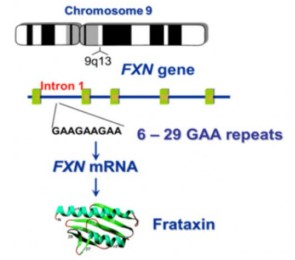
- The faulty gene sits on chromosome 9 called the FXN gene.
- This gene is responsible for providing instructions in making the Frataxin protein that maintains healthy cellular functions.
- A normal FXN gene contains a specific DNA sequence known as GAA (Guanine-adenine-adenine) that repeats between 5 and 33 times- the length of this repeat is crucial for the gene’s normal functioning.
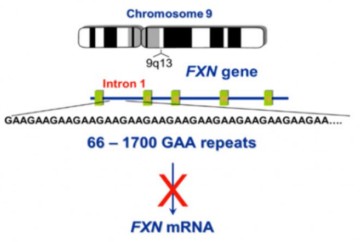
- If the repeat of the GAA sequence expands and becomes longer than normal, then this leads to a significant reduction in the production of the frataxin protein and is indicative of a Friedreich’s Ataxia diagnosis.
- To be clinically diagnosed with FA, at least 1 GAA repeat expansion involves 66 or more repeats in the FXN gene.
Most individuals with FA have between 600 and 1200 repeats- the higher the repeat, usually means lower frataxin levels which can make symptoms start earlier or progress more quickly.
Inheritance Pattern
Two defective FXN genes (one from each parent) are required for someone to develop the disease.
- If a parent has 1 faulty gene, and one normal gene, it means they are “carriers”.
- Carriers will never develop Friedreich’s Ataxia because the one normal gene produces enough Frataxin
to keep the cells healthy enough to function.
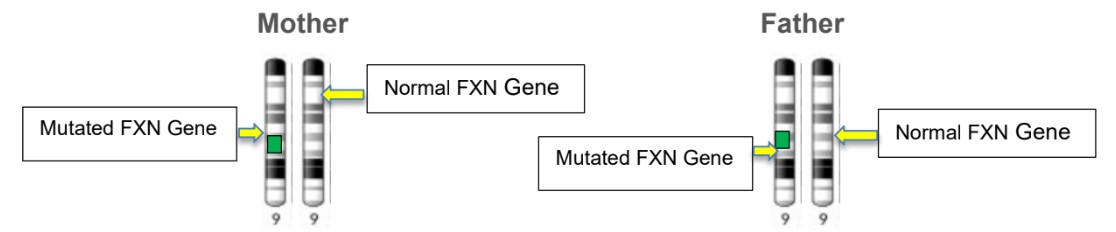
When 2 carriers have a child, the outcome for one child does not affect the outcome for the next child.
Each child has the same probability listed below:
- 25% chance- a child will inherit 2 faulty genes and develop FA
- 50% chance- a child will inherit 1 faulty gene and 1 normal gene and become a carrier
- 25% chance- a child will inherit 2 normal genes- no chance of developing FA or being a carrier
Because every child’s chance is independent, the probability of having multiple children in one family
(siblings) is as follows:
- 2 siblings with FA- 25% x 25% = 6.25% (1 in 16 chance)
- 3 siblings with FA- 25% x 25% x 25% = 1.56% (1 in 64 chance)
- 4 siblings with FA- 25% x 25% x 25% x 25% = 0.39% (1 in 256 chance)
- While it is possible for multiple siblings to inherit FA, the odds get lower as the number affected siblings increases
- Genetic counseling often emphasizes that inheritance is random in each conception.
When a parent develops Friedreich’s Ataxia and has children with a carrier:
- Each child will either be a carrier or manifest the disease.
- The parent with FA- has 2 faulty FXN genes
- The parent who is a carrier- has 1 faulty FXN gene and 1 normal gene
- Each child will inherit a faulty gene from the parent with FA as the faulty gene is the only one that can be passed on
- The chance of developing FA will then depend on the carrier parent
- 50% chance- child inherits a healthy gene from the carrier parent and simply becomes a carrier
- 50% chance- child inherits 2 faulty genes and develops FA.
When a parent develops Friedreich’s Ataxia and has children with a parent that is not a carrier:
- Parent with FA has 2 faulty genes – they can only pass down a faulty gene
- The non-carrier parent has 2 healthy genes and can only pass down 1 healthy gene.
- 100% chance – child inherits 1 faulty gene and 1 healthy gene and will become a carrier.
- 0% chance- child manifests FA because they will never have 2 faulty genes that are necessary to develop the disease.
Testing to Confirm Friedreich’s Ataxia Diagnosis
Proper Evaluations Are Key
Initial Evaluation Based on Symptoms
- The inheritance factor in Friedreich’s Ataxia will usually lead a doctor to discuss your medical history as well as family history if someone presents with the typical balance issues, loss of sensation, and coordination problems.
- This then typically leads to neurological tests that measure reflexes, muscle strength, balance and gait (the way you walk).
- In determining if there are any issues with someone’s gait, the doctor typically observes step length (are steps long, short, or uneven), rhythm (is walking smooth or jerky), balance (does someone wobble or need support), speed, and posture (is someone upright, leaning or stooped).
- Sensory function tests are also taken into consideration because FA damages the nerves that tell your brain where your body is and how it’s moving.
- Tests like moving the big toe up or down with the eyes closed help reveal an early sign of FA which is a loss of proprioception.
- Proprioception is the body’s invisible guide that tells your brain where your arms, legs, and body are without having to look.
- Friedreich’s Ataxia causes that invisible guide to become faint or unreliable, leading the brain to struggle to know exactly where the body is and because of this, balance and coordination become much harder.
- Using a tuning fork on ankles or wrists is another test to determine if there is sensory loss which is an early indicator of FA.
- If a person cannot feel the vibration of the tuning fork, it suggests damage to the sensory nerves which can appear even before severe balance or coordination problems.
- To further test for sensory function, a doctor may use a small pin or touch a patient lightly, and if they feel extraordinary pain then this could also be an indicator of FA.
- Speech and eye movement assessments are completed to determine if there is slow or slurred speech and if there is difficulty with rapid eye movement or tracking.
Molecular Genetic Testing
- The one definitive test that confirms a diagnosis of Friedreich’s Ataxia is molecular genetic testing where a person’s DNA sequence is looked at to identify any mutations or variants in the specific FXN gene.
- DNA is extracted from the sample of blood, saliva, or tissue that is taken from the patient suspected of having the disease.
- It is chosen specifically to identify FA patients because it will confirm or rule out this suspected genetic condition.
- It will confirm if the person is a carrier by identifying if there is one faulty gene in the DNA sequence.
- It will predict if a person has an increased risk of developing the condition.
- It will help guide potential treatment options to reduce symptoms.
Additional Tests After Diagnosis
Electromyography (EMG) and Nerve Conduction
- These tests are usually performed together to show whether problems come from the nerves, muscles, or both.
- Electromyography checks the electrical activity inside muscles
- A tiny needle electrode is inserted into a muscle- the needle senses activity, it does not induce any electrical shocks
- You will be asked to relax and then gently contract the muscle (ex. Bend your arm)
- The electrode records the muscle’s electrical signals on a screen and through sound
- This shows whether muscles are working normally or if nerve damage is preventing them from activating
- In FA, because the disease mainly affects the sensory nerves and not the motor nerves, the EMG results usually appear normal which helps rule out other muscle diseases
Nerve Conduction Study (NCS)
- This tests how well and fast signals travel along a nerve.
- Electrodes are placed on the skin (usually one to stimulate the nerve and another to record the response)
- A small electrical pulse is sent into the nerve (it feels like a quick, mild shock)
- The machine will then record the speed of the signal (conduction velocity) and the strength of the response (amplitude)
- This is repeated for different nerves (in arms and/or legs)
- If someone has FA, the nerve responses are usually reduced or absent because the sensory nerves are damaged
Brain and Spinal Cord Imaging (MRI or CT scans)
- The MRI (Magnetic Resonance Imaging) provides very detailed pictures of the inside of the body especially soft tissues like the brain, spinal cord, heart, and muscles
- The test is painless as you are simply laying down on a narrow table that slides into a large tube
- It can be noisy, but earplugs or headphones are usually provided
- To get a clear picture, you must remain very still
- This imaging allows doctors to see if there are any changes in the brain, spinal cord, and heart
- The changes that may appear in the brain could be mild shrinkage (atrophy) of the cerebellum- the part of the brain that coordinates movement, balance, speech and motor-learning.
- It may also show subtle changes or atrophy in the brainstem (helps control movement and vital functions)
- If there are spinal cord changes, it may show an actual thinning of the spinal cord especially in the cervical and thoracic regions (neck, and upper back)
- An MRI can measure heart size, pump function, and detect if scarring is present which can be an indicator of hypertrophic cardiomyopathy (thickening of the heart muscle)
- Friedreich’s Ataxia cannot be diagnosed solely with the MRI test, but it can help distinguish FA from other ataxias, multiple sclerosis, or structural spinal cord problems
- A CT scan (Computed Tomography) is used with an X-ray and a computer to create detailed cross-sectional images of the inside of the body
- The test itself is similar to the MRI as you lay on a table, and it slowly moves through an opening while an x-ray beam rotates around your body making many pictures from different angles
- A computer then puts the pictures together to create a very detailed 2D or 3D image
- CT scans can detect changes in the brain and head such as bleeding, stroke, tumors, or injuries
- It can grab images of the lungs, heart, liver, kidneys, and intestines
- CT scans are better than x-rays because it reveals information in the bones and joints and can identify fractures and other problems
- It also reveals any blockages or aneurysms in blood vessels once a special contrast dye is injected
into body prior to getting the scan.
Heart Tests (ECG & Echocardiogram)
- Heart disease is one of the most serious complications of Friedreich’s Ataxia
- These tests help catch problems early, guide treatment, and monitor changes over time
- An ECG (Electrocardiogram) checks the heart’s rhythm/electrical system
- This test is quick and painless that uses sticky patches (electrodes) on the chest, arms, and legs to identify if there are any abnormal rhythms, problems with the electrical wiring of the heart (conduction), or changes in size
- An Echo (Echocardiogram) checks the heart’s structure and pumping ability (mechanical system)
- This type of test is an ultrasound of the heart and like the ECG, it is painless
- It provides a clear picture of the size and thickness of the heart muscle, how well the heart pumps blood, any valve problems, and if there is stiffening of the muscle (diastolic dysfunction).
Blood Tests
- Checking blood provides an overall picture of the health of the patient and signals if closer monitoring is necessary.
- Blood tests can reveal if any markers for heart stress or damage have occurred
- Cholesterol levels and metabolic markers are checked to confirm if there is any imminent risk to heart disease
- Screens for diabetes which is a common complication of FA
- Provides a story of how other medications and supplements are affecting the body and to monitor potential damaging side effects on the liver, kidneys, or blood counts.
- Blood work helps exclude anemia, thyroid problems, or vitamin deficiencies.
Disclaimer:
The information on this website is provided for educational and awareness purposes only. It should not be taken as medical advice, diagnosis, or treatment. Always seek the guidance of a qualified healthcare professional with any questions you may have regarding a medical condition. Never disregard professional medical advice or delay seeking it because of something you have read here on this website.